Prinsoners from the Front,1866 by Winslow Homer
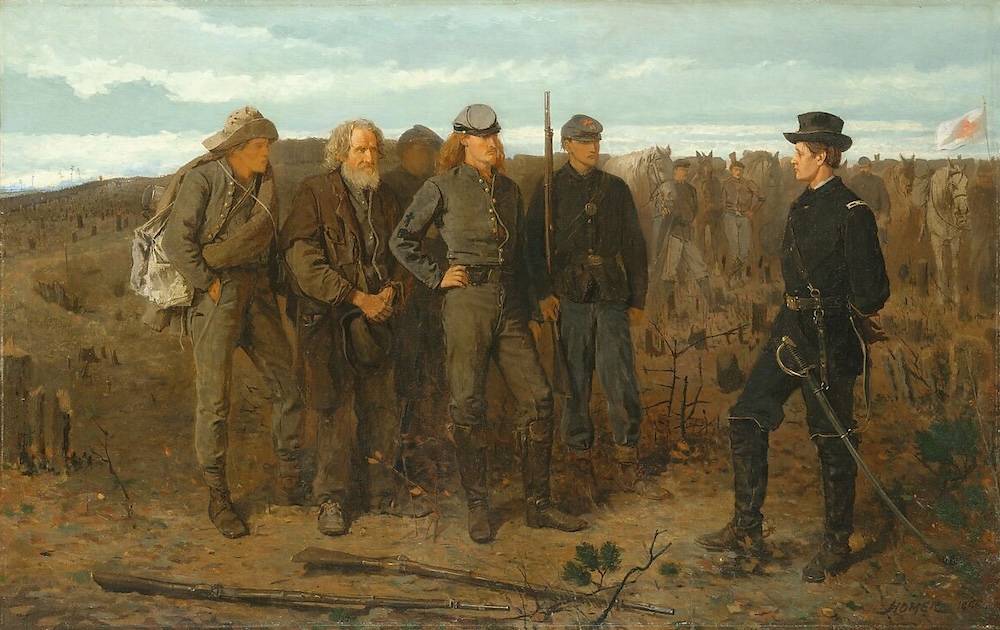
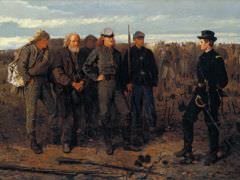
The material that Homer collected as an artist-correspondent during the Civil War provided the subjects for his first oil paintings. In 1866, one year after the war ended and four years after he reputedly began to paint in oil, Homer completed the picture Prisoners from the Front, one of Homer's most famous and highly lauded paintings of the Civil War, a work that established his reputation.
It represents an actual scene from the war in which a Union officer, Brigadier General Francis Channing Barlow (1834-1896), captured several Confederate officers on June 21, 1864. The background depicts the battlefield at Petersburg, Virginia.
It is a scene without exciting action or schematic devices, yet a kind of nobility and emotional drama pervades the canvas. Homer expertly characterized the range of personalities involved in the war, from the young, uncertain boy being captured to the bearded old man, humbly submitting to his fate, to the proud challenging stance of the third man still dressed in Confederate uniform. We feel the tension between Barlow and the Confederated soldier, yet it never threatens the stability of the image. Homer seemed to emphasize the sense of unity and spirit of a nation acknowledging a new direction.
General Barlow was not only a friend whom Homer had visited at the front at least once and probably more often than that, but was also "one of the most eminent" officers to survive the war. Barlow had a record of valorous military service in which, particularly, "he distinguished himself at the Wilderness by leading his division in the grand charge which resulted in the capture of the rebel General Ed. Johnson's entire division" - an incident of which Homer's painting can easily be considered a symbolic representation.
Infrared photography and numerous studies indicate that the painting underwent many changes in the course of completion.